Pineapple Weed

Matricaria discoidea. Also called wild chamomile, because it’s in the same family (asteraceae) and has similar properties to both Roman & German Chamomile. Unlike chamomile, you won’t see small white ray flowers, but instead has tiny, cone-shaped yellow flowers that are actually comprised of many tubular yellow-green small flowers. Both the flowers and the fern-like leaves smell sweet. Leaves and flowers contain Vitamin C, Iron, Calcium, and Potassium. You’ll find it in loose, rocky, soil like gravel driveways and it loves full sun. I start seeing the flowers in bloom starting late May in Michigan.
Edible: Leaves & flowers. The flowers are sweet and reminiscent of pineapple, thus the name! The leaves also smell sweet, but have more of a mild taste. *Don’t overeat, like huge salads of them. While non-toxic, too much can cause stomach upset. Don’t eat/use if allergic to ragweed or daisies.
Harvest: Cut the plant with scissors, then bring it inside and refresh in cold water for 15 minutes. Drain well, then roll in a towel and store in a silicone bag or covered glass container in the refrigerator until ready to use.
Uses: Mild carminative (eases gas, aids digestion) and mild nervine (relaxant). May aid in sleep and menstrual discomfort. These uses are best when fresh or dried and steeped in hot water as an herbal infusion (tea). Can also be tinctured. Can also act as a mild insect repellent when crushed and wiped across skin due to its high presence of neryl isovalerate.
Fun Foods: Pick fresh flowers when yellow and cut leaves and stems, add to: salads, lemonade, add to salad dressings, hot water for a tea, use to decorate the top of cookies or muffins. You can also make a fresh Pineapple Weed syrup by combining 3 cups of fresh pineapple weed (or ½ cup dry) and mix with 1 cups of water and 2 cups of sugar, bring to a boil, remove from heat and cool. Allow to infuse overnight, then strain and store in jar in the fridge. Makes about 2 cups. Dried Pineapple Weed is often added to homemade trail mix. Pineapple Weed flowers can be dried, then ground to make a flour for baking.
Brill, S. (1994). Identifying and harvesting edible and medicinal plants. New York: Hearst Books.
Moerman, D. E. (1998). Native American Ethnobotany. Portland, Oregon: Timber Press.
Duke, J. A. (1986). Handbook of Northeastern Indian Medicinal Plants. Lincoln, MA: Quarterman Publications, Inc.
Bloodroot
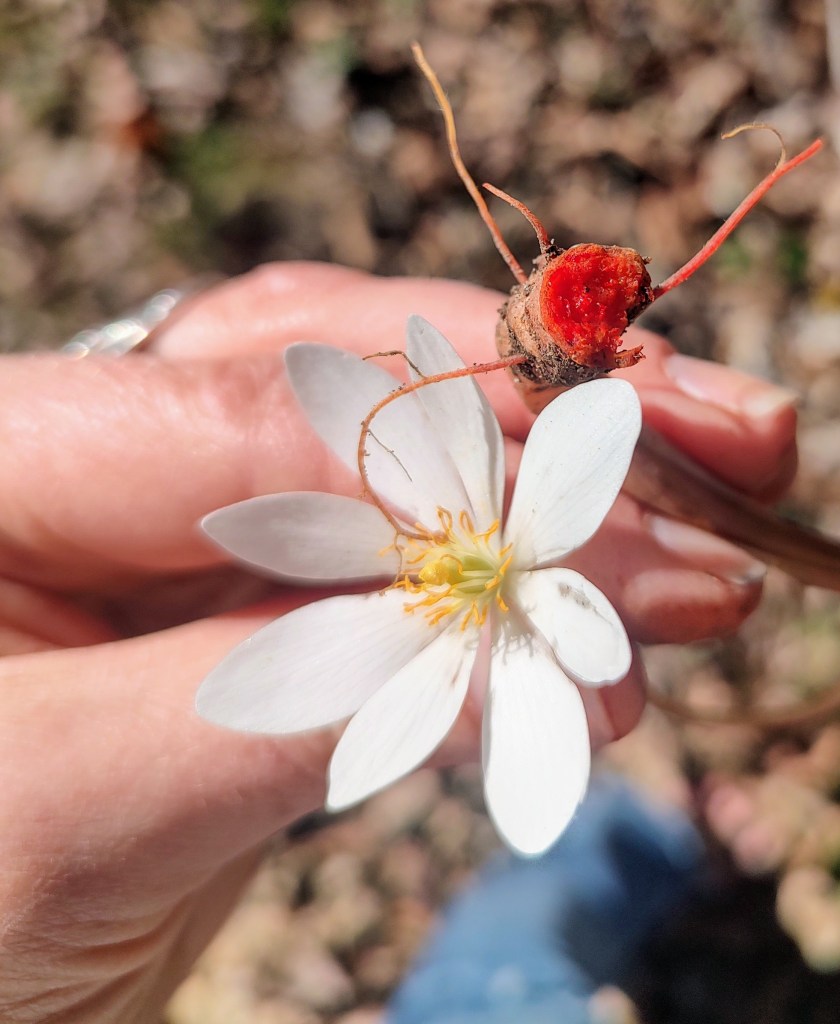
Sanguinaria canadensis. A woodland perennial, herbaceous flowering plant native to eastern North America. It is the only species in the genus Sanguinaria, included in the poppy family Papaveraceae. fragile spring flower develops and rises from the center of its curled scalloped leaf, opening in full sun, and closing at night. These sweet flowers only last a few days. If the flowers are not pollinated in three days, the stamens will bend down to touch the stigma and self-pollination occurs. It’s seeds are spread by ants, a process called Myrmecochory. I find these in the woods in Michigan around mid-April, after the sun as been able to warm the woods floor for a week or so.
Edible: Flowers, leaves, and roots are toxic in high doses or over prolonged ingestion. Because I see far less Bloodroot than I did when I was young, I do not forage for eating. I also do not want to disturb the flowers, so they can pollinate.
Harvest: Native American traditional wisdom says “gather less than 1/3 of what you find”, but I tend to be even more conservative with harvesting rhizomes. It’s highly susceptible to farming chemicals, it has a lot of competition with invasive weeds, and deer like to eat it. It’s special, and becoming rare, so I’m careful. It’s also a strong herbal, so it doesn’t take much to make an ointment, poultice, or a tincture.
Uses: It’s the blood-red sap that is found in all parts of the plant, especially in the thickened roots (rhizomes), that has traditionally been used for either dye or as an herbal remedy for certain health ailments including treating skin wounds, and supporting healthy blood. The sap is high in medicinal alkaloid sanguinarine. Do not get in the eyes, and only use for a short period of time on skin. Internal use needs to be reputably researched by the user for safety and for what ailments. This is not a benign plant, but sometimes the body doesn’t need benign. You can learn more about its traditional uses and safety, here: https://www.ncbi.nlm.nih.gov/pmc/articles/PMC5037693/
 The Healing Reign